Two years ago I moved into a rented flat with north-facing windows and a landlord who forbade drilling. No balcony. No garden. And a stubborn belief that I could still make the place feel like a forest clearing. What actually worked surprised me — it wasn't the fiddle-leaf fig I killed within weeks, but a €9 jute rug, a repositioned mirror, and one very deliberate lamp.
That's the thing about biophilic design ideas for a natural home: most of us assume it means buying more plants. It doesn't. It means engineering the conditions your nervous system actually reads as "outside" — light direction, texture, sound, smell, and a view that isn't a wall. Get those wrong and a room full of greenery still feels like an office with a ficus problem.
Key takeaways
- Biophilic design works on the senses, not the shopping list. Light, texture, sound and views do more than plant count.
- Renters can achieve roughly 80% of the effect with removable fixings and no permanent structural changes.
- A single wall of greenery is often a worse investment than layered texture plus one strong sightline to the outdoors.
- The 3-5-7 rule is a styling guideline, not science — useful as a starting point, unreliable as a system.
- Most people over-buy plants and under-buy daylight. Start by mapping where light actually lands at 9am, noon and 4pm.
Biophilic design ideas that actually change how a room feels
Here's my working definition, shaped by two years of trial and error: biophilic design is the practice of removing the cues that tell your body it's indoors. Fluorescent flicker. Flat even light. Sharp 90-degree corners. Synthetic surfaces that reflect sound. Silence where birds should be.
Start with light, not plants
I made this mistake first. I bought six plants, arranged them beautifully, and the room still felt like a waiting area. The problem was the ceiling light — a 4000K panel that made everything look like a dentist's reception. Swapping it for warm 2700K bulbs on a dimmer changed the room more than any plant did.
What to do, concretely:
- Track the sun before you buy anything. Spend one day noting where direct light hits at three different hours. That map tells you where seating, plants and mirrors belong.
- Use mirrors as artificial windows. A large mirror angled toward the brightest external wall roughly doubles the perceived daylight in a dim room. Mine was €35 from a second-hand shop.
- Dimmer switches where possible. In a rental you'll often need plug-in dimmers — cheap, removable, effective.
- Sheer curtains in cool bedrooms and heavier linen in living rooms, purely so you can modulate brightness by season.
Flat, even light is the enemy. Nature gives you directional light with contrast — dappled shade, a bright patch on a wall, a dark corner. Chase contrast, not brightness.
Texture does more work than colour
My own experiment: I painted a room sage green and felt almost nothing. Then I added a rough jute rug, a wool throw, a linen cushion and a stoneware jug. The change in felt atmosphere was immediate. Colour is read by the eye; texture is read by the hand and the ear.
Material layering that stays cheap and renter-friendly:
- Floor: a jute or sisal rug — the coarseness matters, this is the anchor.
- Mid-level: linen, cotton or wool textiles at sitting height, where your hands and arms meet them.
- Touch points: a wooden or stone bowl by the door, a clay plant pot rather than plastic, a wool throw on the sofa arm.
- Ceiling: a paper or fabric pendant shade that softens light rather than a bare bulb.
- Sound: a textile wall hanging or a heavy curtain actually deadens echo, which is why a furnished room feels calmer than a bare one.
Real cost for my 40m²: about €120 total, spread over four months. Not nothing, but far below the €300+ I nearly spent on a single designer planter.
What are some examples of biophilic design for a house?
The clearest examples are the ones that work on more than one sense at once. A window seat that gets morning light and looks onto a tree does light, view and comfort in one move. A herb planter by the kitchen sink gives smell, touch and a small daily task. A water feature you can hear but not see.

Concrete examples I've seen work in residential settings:
- A sightline to green. If you have a garden, position your main chair so the longest view is outward, not inward. In flats, that means clearing the windowsill of clutter entirely.
- An indoor water element. Even a small tabletop fountain shifts the soundscape. I'll be honest: mine ran dry twice and I gave up. But when it worked, it worked.
- Planting in groups of the same species. Nature repeats itself. Three identical ferns read more naturally than three different plants in a row.
- Wood grain left visible. Oiled oak versus laminate is obvious to the touch, even when the look is similar.
- An entry sequence. A porch, a step down, a change of flooring. Small thresholds signal arrival — one of the cheapest tricks to borrow.
Note what's missing from that list: expensive. Biophilic design's biggest commercial distortion is the assumption that it requires a commissioned living wall.
What is the 3-5-7 rule in interior design?
The 3-5-7 rule is a styling guideline that suggests grouping decorative objects in odd numbers — typically sets of three, five or seven — with varying heights and sizes, to create a composition that feels balanced rather than static. The idea is that odd numbers resist symmetry, and symmetry has a slightly formal, staged quality to it. Nature rarely pairs things off perfectly.
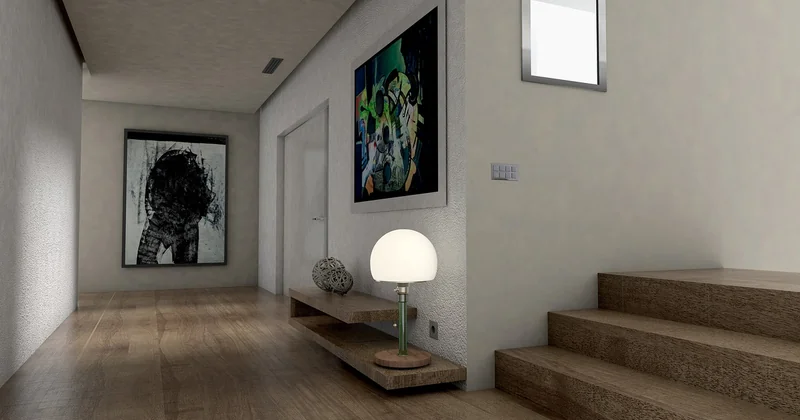
Does it hold up? Partly. The odd-number instinct has a real basis in how we read visual groupings, and it's a handy prompt when you're stuck. What I'd push back on: it's presented as a rule when it's really a default. A row of five identical ferns looks like a shop display. Three objects of wildly different scale can look like clutter. What actually matters is variation in height and texture, not the count.
My practical version: aim for odd groupings on open surfaces, keep them to one species or one material family, and vary height by at least a third. If you can't decide, fewer is nearly always better.
What are the 14 patterns of biophilic design?
The 14 patterns of biophilic design are a framework developed by Terrapin Bright Green, first published as a report and now widely used by architects and workplace designers. It groups the ways nature affects us into fourteen patterns rather than one general "add plants" instruction. I find the framework useful less as a checklist and more as a diagnostic — when a room feels wrong, running through it usually finds the culprit.

The patterns are usually grouped into three clusters: nature in the space (direct sensory contact), natural analogues (indirect references), and nature of the space (spatial configuration). I won't pretend to memorise all fourteen, but a few have changed how I set up rooms:
- Visual connection with nature. A view of something living. This is the big one, and the one flats fight you on.
- Non-visual connection. Sound, smell, touch. Rain on glass, a scented herb, a wool blanket.
- Prospect and refuge. Being able to see far while feeling enclosed. This is why people gravitate to window seats and corner sofas.
- Material connection with nature. Real wood, real stone, real fibre.
- Complexity and order. Enough variation to be interesting, enough pattern to be legible. A room that is either chaotic or sterile fails here.
The most useful pattern in my experience is prospect and refuge. It explains a lot of otherwise baffling furniture arrangements — and why a sofa placed with a wall behind it feels comfortable while a sofa floating in the open doesn't.
Can you give me 10 examples of natural design?
Ten examples, chosen because they're achievable in an ordinary home rather than a showpiece build:
- Map the light and move your main seating into the brightest hour-long patch.
- Clear one windowsill completely. The frame becomes a view rather than a shelf.
- Add a jute or sisal rug under the main seating area for texture and sound absorption.
- Switch to warm bulbs in the rooms you use after dark.
- Group three of the same plant species at varying heights.
- Hang one large textile — a wool hanging or heavy curtain — to break echo.
- Introduce a real wood surface at a hand-touch point: a chopping board left out, a wooden tray, a side table.
- Angle a mirror toward the brightest wall.
- Add one scent source that's living — rosemary, mint, basil on the windowsill.
- Create an entry threshold with a change of flooring material at the door.
A comparison worth knowing before you spend
I've tried all of these. Here's roughly how they rank on effort versus impact, based on my own flat:
| Idea | Cost | Effort | Impact on how the room feels |
|---|---|---|---|
| Warm bulbs + dimmer | Low | Minutes | Very high |
| Jute rug | Low-mid | Minutes | High |
| Mirror angled to light | Low | Minutes | High |
| Textile wall hanging | Low | An afternoon | Moderate (mostly sound) |
| Living wall or plant wall | High | Weeks, ongoing care | Variable — often disappointing |
Small, rental-friendly moves that punch above their weight
The landlord problem is real, and most biophilic advice ignores it. You can't knock through a wall or install a skylight. So here's what I'd actually do again, knowing what I know now.
Plants that survive a dim rental
This is where I lost money. Fiddle-leaf figs and calatheas died. What survived, and still survives, is the boring list: pothos, snake plant, ZZ plant, spider plant, and a rubber plant near the brightest window. Low-light plants won't grow fast, but they won't sulk either. Buy fewer than you think, and buy two of each so they read as a planted group rather than a collection.
The ventilation question nobody brings up
Air quality is part of biophilic design and almost never mentioned in the styling articles. Open a window for ten minutes twice a day even in winter — the stale-air feeling in a sealed flat is half of why it feels unnatural. In my own flat, the single most noticeable change after a year wasn't visual at all. It was that I stopped closing the window overnight.
Which is a decent place to leave this. Most of us go looking for biophilic design ideas for a natural home expecting a shopping list of objects, and the objects are the easy part. The harder question is whether your room gives your body any reason to believe it's somewhere else. A €9 rug and an open window did more in my flat than €300 of plants. Start there, and see what you notice by the end of the week.